


Table of Contents
- What You'll Need Before You Start Auditing Your Closet
- Step 1: Read the Fiber Content Label to Identify Non Toxic Clothing
- The Best Natural Fabrics for Sensitive Skin
- Step 2: Check Certifications Like OEKO-TEX Standard 100 and GOTS
- Step 3: Spot Harmful Chemicals and Finishes in Clothing
- Step 4: How to Wash New Clothes to Remove Chemicals
- Common Mistakes to Avoid When Identifying Non Toxic Clothing
- Conclusion
- Frequently Asked Questions
Last Updated: September 25, 2026
What You'll Need Before You Start Auditing Your Closet
Learning how to identify non toxic clothing starts with the label inside your shirt. This guide from Natural Clothing Company walks through a four-step audit anyone can run at home, not to toss your whole closet, but to know what you own and choose better going forward.
Step 1: Read the Fiber Content Label to Identify Non Toxic Clothing
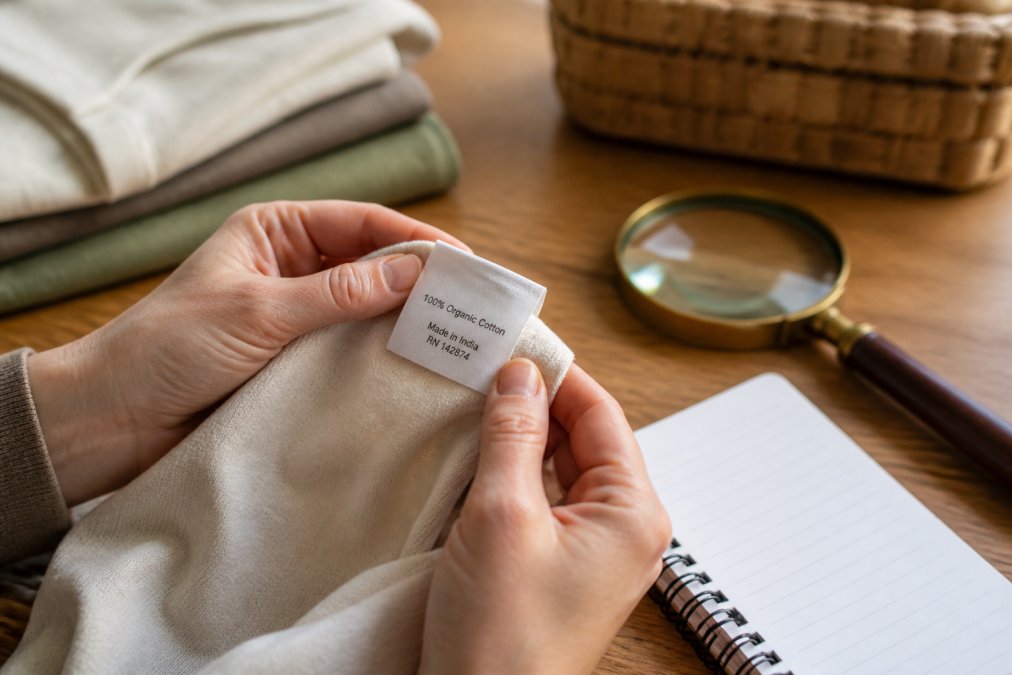
Fiber content is the fastest clue to what you are wearing.
Fiber Red Flags: What to Avoid
Watch for these on any label:
- "Polyester," "nylon," "acrylic," or "spandex" listed first (the first fiber is the largest share)
- "Cotton" with no "organic" or "certified organic" wording
- Vague terms like "performance fabric" or "moisture-wicking" that hide chemical treatments
- "Wrinkle-resistant" or "no-iron" claims that usually point to finishing agents
- Blends under 5% synthetic used only for stretch, which are harder to avoid
A common mistake is trusting front-of-pack words like "natural" or "pure." Only the fiber panel is regulated. Everything else is marketing.
The Best Natural Fabrics for Sensitive Skin
Some natural fabrics suit reactive skin better than others. Undyed organic cotton, linen, and hemp breathe, resist static, and need fewer chemical finishes than synthetics. Here is how the main options compare:
| Fabric | Breathability | Dye Options | Best For |
|---|---|---|---|
| Organic cotton | High | Low-impact, undyed | Everyday wear, undergarments |
| Linen | Very high | Natural, plant-based | Warm weather, breathable layers |
| Hemp | High | Low-impact | Durable basics, long wear |
| Wool (untreated) | Medium | Natural | Cool-weather layers |
| Bamboo viscose | Medium | Often chemically processed | Softness, but check processing |
Step 2: Check Certifications Like OEKO-TEX Standard 100 and GOTS
Certifications turn a vague "natural" claim into something you can check. Two matter most.
Understanding OEKO-TEX Certified Clothing Brands
A brand can carry OEKO-TEX certification on one product line and not another. That is why the label, not the brand name, is the thing to check.
Step 3: Spot Harmful Chemicals and Finishes in Clothing
Some chemicals hide in the finish, not the fiber. A garment can be 100% organic cotton and still carry a stain-repellent coating, a wrinkle-resistant resin, or a dye carrier. This step is about reading the finish, not just the fiber panel.

How Finishes Get Applied (and Why They Stick)
Most functional finishes are applied as a liquid bath or spray during wet-finishing, then cured with heat, which bonds the chemistry to the fiber surface, why a single home wash rarely removes it all. The three application types you will encounter most:
- Pad-dry-cure: fabric is dipped, squeezed, dried, then baked. Common for wrinkle-resistant and durable-press finishes.
- Coating and lamination: a polymer layer is bonded to the surface. Common for water-repellent and stain-release finishes.
- Exhaust application: the garment absorbs chemistry from a bath. Common for softeners, anti-static agents, and some dyes.
PFAS, Formaldehyde, and Azo Dyes
PFAS are stain- and water-resistant coatings used on some outdoor gear, uniforms, and "easy-care" garments. They are persistent chemicals, and the EPA overview of PFAS notes they break down very slowly in the environment and in the body. Look for them on anything marketed as stain-proof, water-repellent, or quick-dry.
Other chemicals to know:
- Heavy metals used in some metal-complex dyes, especially for dark and bright shades
- Chlorinated phenols used as preservatives during shipping and warehouse storage
- Flame retardants applied to some children's sleepwear and upholstery-adjacent textiles
- Optical brighteners left on white garments to make them look brighter than the fiber actually is
- Phthalates used as plasticizers in some screen-print inks and plastisol prints
Home Detection: What You Can Actually Test
You do not need a lab to narrow things down. These at-home checks are screening tools, not proof.
Never rely on smell alone to judge a garment. Formaldehyde and other finishing agents can be present with little or no odor, so a "fresh" smell does not mean a clean fabric, and a lack of smell does not mean a clean fabric either.
What You Cannot Test at Home
Be honest about the limits. Home tests can flag a finish, but they cannot tell you which chemical is present, at what concentration, or whether it will affect you. Azo dyes, heavy metals, and chlorinated phenols are not detectable by sight, smell, or touch. That is why certification (Step 2) and fiber choice (Step 1) carry more weight than any DIY test.
Treat home testing as a triage tool, not a verdict. It tells you which garments deserve a closer look, an extra wash, or a spot in the donation pile.
Allergy Organic Cotton Socks →
Step 4: How to Wash New Clothes to Remove Chemicals
Washing new clothes before wearing them reduces surface chemical residues. It does not remove everything, cured resins and bonded coatings largely stay put, but for loose dyes, finishing dust, and storage preservatives, it is the highest-return step you can take. It is also where a lot of "clean" wardrobes quietly get re-contaminated.
Why Washing Helps (and What It Cannot Do)
Water and agitation rinse away surface chemistry: unfixed dye, residual softeners, anti-static agents, and shipping preservatives. Heat helps some finishes release. What washing cannot do is unbond a cured wrinkle-resistant resin or strip a laminated water-repellent coating, those are chemically attached to the fiber now. So the goal is realistic: reduce what is loose, and do not add anything new.
The Washing Sequence
- Wash before first wear, especially anything worn next to the body. Skin contact plus warmth plus moisture pulls residues out of fabric and onto skin.
- Use fragrance-free, dye-free detergent. "Free and clear" formulas avoid the perfumes and optical brighteners that standard detergents deposit on fabric.
- Skip fabric softener and dryer sheets. Both leave a waxy or silicone film, a chemical coating you are voluntarily adding to a garment you just tried to clean.
- Wash in warm water for cotton and linen; check the care label first. Warm water releases more residue than cold, but hot water can set some dyes and shrink natural fibers.
- Add an extra rinse cycle. One rinse leaves detergent and loosened residue behind; a second flushes more out.
- Line dry in sunlight when possible. UV light helps break down some surface residues, and sun-drying avoids the heat-set effect of a dryer on any remaining finish.
- Wash separately the first time. New garments shed dye and finish into the wash water, so washing them alone keeps that off already-clean items.
For very reactive skin, washing twice before the first wear is a reasonable extra step. It is not a guarantee, sensitivities vary from person to person, but it lowers the residue load further.
The Laundry Product Problem Most Guides Miss
Here is the gap: a reader can buy the cleanest undyed organic cotton garment available, then reintroduce fragrance, optical brighteners, and softening agents in the first wash. The detergent aisle is where a non-toxic wardrobe is most often undone.

Watch for these on a detergent label:
- "Fragrance" or "parfum", an umbrella term that can cover dozens of undisclosed compounds
- Optical brighteners (also listed as fluorescent whitening agents), they stay on fabric to make whites look brighter
- Fabric softeners and cationic surfactants, they coat fiber and reduce absorbency
- Enzymes and bleach alternatives, useful for cleaning, but they can leave residues on natural fibers
- Scent beads and booster packs, concentrated fragrance delivery, the opposite of what you want
Maintenance Habits That Keep Clothing Clean Over Time
Post-purchase care is not a one-time event. A few habits keep a garment from drifting back toward the chemical load you worked to avoid:
- Wash less often. Overwashing breaks down fibers and can release more finish over time. Air garments between wears when possible.
- Do not over-dry. High dryer heat can set finishes and shrink natural fibers. Line dry or use low heat.
- Keep a separate load for new items. The first two or three washes are when the most residue comes off.
- Re-wash secondhand finds before wearing. They carry their own history of detergents, softeners, and storage.
- Rotate, do not hoard. A smaller wardrobe that gets washed and worn regularly is easier to track than a closet full of items whose history you cannot remember.
Washing removes what is loose and leaves what is bonded. The bigger win is what you do not add back, fragrance-free detergent, no softener, no dryer sheets, and a separate first wash for anything new.
Common Mistakes to Avoid When Identifying Non Toxic Clothing
Even careful shoppers trip on the same few errors:
- Trusting front-of-label words like "natural" or "eco" instead of the fiber panel
- Assuming a brand is consistent, when certification often applies per product line
- Ignoring the finish and checking only the fiber
- Skipping the pre-wash and wearing new items straight from the bag
- Overlooking trims, since elastic, thread, and zippers can carry their own treatments
- Buying all at once, when testing one item first tells you more
A common mistake is treating "organic" and "non-toxic" as the same claim. Organic cotton can still be dyed and finished. Both the fiber and the finish need checking.
Conclusion
Auditing a closet takes an afternoon, but the habit sticks for years. Read the fiber panel first, then check for GOTS or OEKO-TEX, then question any "performance" finish, and always wash before you wear.
Frequently Asked Questions
What is the 3-3-3 rule for clothes?
The 3-3-3 rule is a minimalist wardrobe guideline: wear each new garment within 3 days of purchase, keep only 3 months of seasonal clothing accessible, and replace items every 3 years. For non-toxic clothing, it encourages buying fewer, higher-quality pieces, which reduces exposure to chemical finishes and supports sustainable apparel choices.
Is 92% cotton and 8% spandex toxic?
Not inherently toxic, but spandex (elastane) is a synthetic fiber that can contain chemical residues from processing. For sensitive skin, 100% organic cotton is often preferred because it avoids synthetic fibers and their potential irritants. If you choose a blend, look for OEKO-TEX Standard 100 certification to ensure chemical safety.
How do I read clothing labels to identify non-toxic materials?
Start by checking the fiber content: prioritize natural fibers like organic cotton, hemp, and linen. Look for certifications such as GOTS or OEKO-TEX Standard 100. Avoid terms like 'wrinkle-resistant' or 'moisture-wicking' unless the brand provides proof of PFAS-free finishes. Also, check for 'undyed' or 'low-impact dyes' to reduce chemical exposure.
What are the most common toxic chemicals found in clothing?
Common toxic chemicals in clothing include PFAS (for stain resistance), formaldehyde (in wrinkle-free finishes), azo dyes (which can release carcinogenic amines), heavy metals (from dyes), and chlorinated phenols (as preservatives). These can cause skin irritation and may be absorbed through the skin. Choosing certified organic or OEKO-TEX certified clothing helps avoid them.


Leave a comment